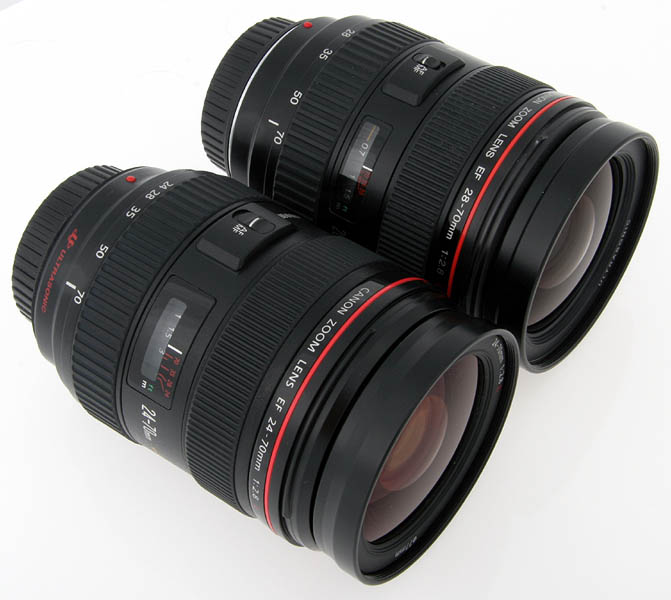
Review
of the Canon EF 24-70mm f/2.8L and EF 28-70mm f/2.8L USM Lenses
|
These are simply among the highest quality and best performing zoom
lenses ever designed and manufactured for full-frame 35mm and digital
cameras. The EF 28-70mm f/2.8L lens was superceded by the EF 24-70mm
f/2.8L lens. Both lenses are superb, and I hesitated replacing my
28-70 with the 24-70 because the older version of the lens was so
good. However, the extra coverage at 24mm is very useful.
I had been skeptical of potentially exaggerated advertising
statements from Canon proclaiming in effect that they had made a great
L-zoom even better. They improved lens performance in the 24-70mm with
respect to sharpness (resolution and 50% MTF [modulation transfer
function]) except at 70mm. Linear distortion and chromatic aberration
are still mild, but more noticeable in the 24-70 than in the 28-70 if
you shoot with a full frame camera such as the EOS-1Ds. |
 |
Strong points of both these
lenses:
- High resolution and contrast with excellent color
Performance meets or exceeds that of non-L prime lenses
- Minimal to mild linear distortion
- Fast autofocus
- Superb construction
|
The price of imaging
excellence with these lenses:
- Heavy and large
- Expensive
|
Resolution and 50% MTF Performance Data
Link to
Methods Used
24mm
Resolution
and 50% MTF are generally higher in the 24-70mm f/2.8L zoom than in the
24mm f/2.8 prime. The zoom has mild barrel distortion at 24mm. Corner
sharpness in the EF 24-70mm is better than in the prime. |
 |
 |
28mm
Resolution
and 50% MTF are better in both the 28-70mm and the 24-70mm f/2.8L zooms
than in the 28mm f/2.8 prime. 50% MTF is better in the 24-70 than in the
28-70. |
 |
 |
50mm
The
24-70 has better MTF performance than the 28-70 at f/2.8 and f/4. The
50mm f/1.4 prime outperforms the zooms at f/4 and f/5.6. |
 |
 |
70mm
The
EF 28-70mm has better 50% MTF performance at f/2.8 and f/4 than the
24-70mm lens at this focal length. |
 |
 |
Linear Distortion
Linear distortion is slightly more severe in the EF 24-70mm lens than
the EF 28-80 as would be expected for a wider range zoom. The EF 50mm
prime also has linear distortion.
|
EF 24-70mm f/2.8L |
EF 28-70mm f/2.8L |
EF 24mm f/2.8 |
EF 28mm f/2.8 |
EF 50mm f/1.4 |
| 24mm |
mild
barrel |
|
none |
|
|
| 28mm |
negligible barrel |
negligible barrel |
|
none |
|
| 50mm |
negligible pin cushion |
mild pin cushion |
|
|
mild barrel |
| 70mm |
mild pin cushion |
mild pin cushion |
|
|
|
Chromatic Aberration in Image Corners with
EOS-1Ds
Mild lateral chromatic aberration in the far corners of images is a
common finding in wide angle lenses used with the EOS-1Ds. The EF 28-70mm
f/2.8L outperforms the EF 24-70mm lens in this area. Examples below in the
table are from the far left upper corner of this
chart.
|
EF 24-70mm f/2.8L |
EF 28-70mm f/2.8L |
EF 24mm f/2.8 |
EF 28mm f/2.8 |
EF 50mm f/1.4 |
| 24mm |
mild |
|
mild |
|
|
| 28mm |
mild |
mild |
|
moderate |
|
| 50mm |
mild |
none |
|
|
negligible |
| 70mm |
negligible |
none |
|
|
|
Gallery
(mostly with the EF 28-70mm f/2.8L and EOS-1Ds)
Conclusion
The EF 28-70mm f/2.8L and EF 24-70mm f/2.8L are high quality
professional zoom lenses that perform better in most cases than non-L
prime lenses in their range in producing sharp, contrasty images with
excellent color. The L-primes (e.g., EF
35mm f/1.4L) still offer a slightly higher level of
performance. The EF 24-70mm offers the advantages of wider perspective at
24mm and generally higher MTF at wide angles than the EF 28-70mm f/2.8L.
This better wide angle performance of the EF 24-70 comes at the cost of
slightly lower 70mm MTF performance at wide aperture and slightly greater
linear distortion and chromatic aberration.
The
EF 24-70mm f/2.8L is compared with the EF 24-105mm f/4L IS and the EF
28-135mm f/3.5-5.6 IS lenses here.
Equipment
Review Index
Home
©
2004, William L. Castleman
Initially
posted 19 October, 2004, Updated 14 June 2006